
Business English(Live Classroom – Book Your Seat Now)
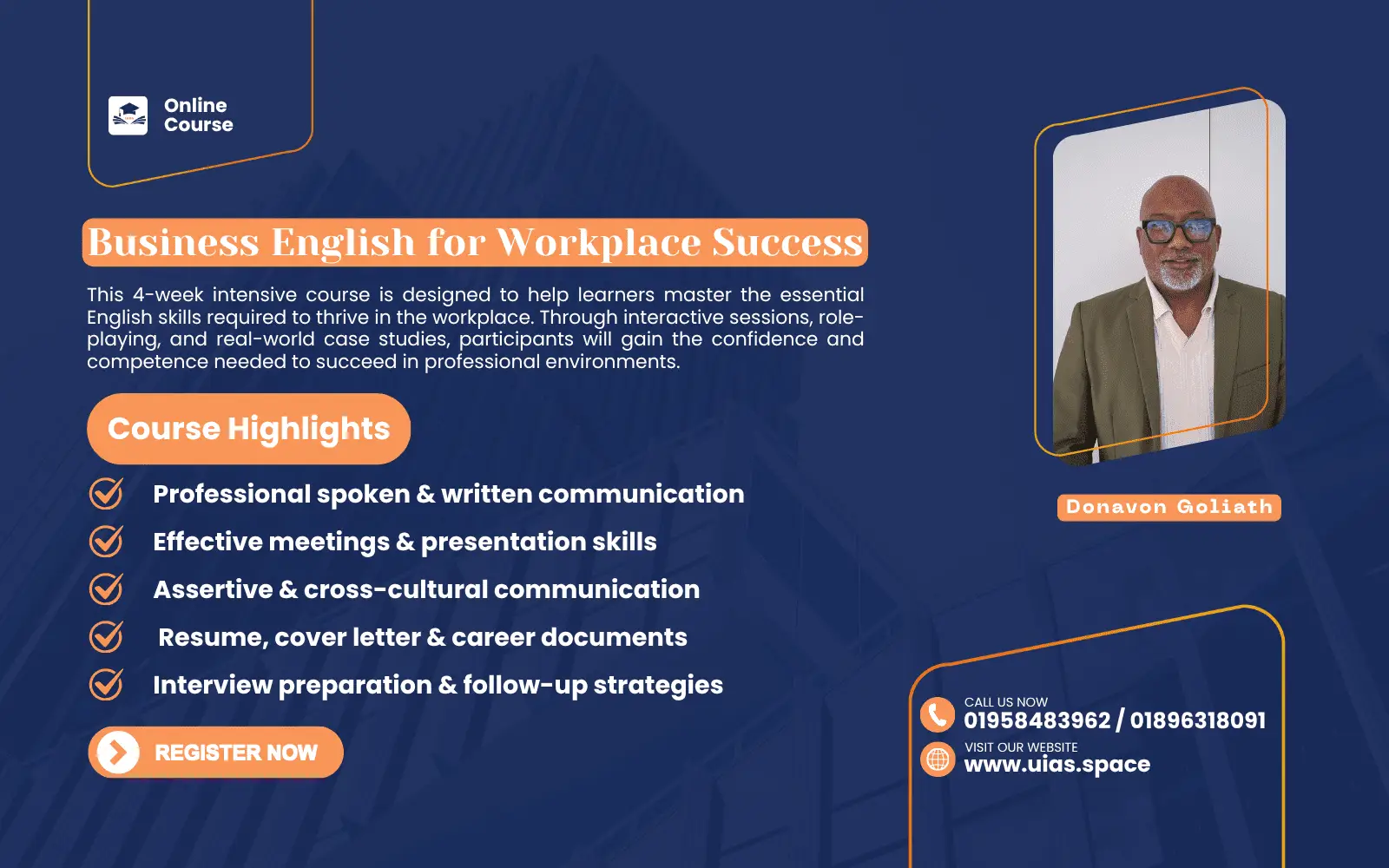
About Course
Introduction Session: Setting the Foundation (40 Minutes)
- Welcome and Introductions: A brief icebreaker to help students feel comfortable and share their personal goals for the course.
- Course Overview: An explanation of the course structure, modules, and learning objectives.
- Needs Assessment: A short, informal poll to gauge student proficiency and specific communication challenges.
- The “Why” and The “How”: Using poll results, the instructor will demonstrate how the course directly addresses the most common challenges by providing actionable mini-lessons and examples.
Week 1: Foundational Communication (2 Hours)
Session 1.1: Spoken Communication – Greetings & Small Talk (1 hour)
- Objective: Build confidence in professional introductions and small talk.
- Topics: Greetings and Introductions (formal and informal), Small Talk strategies for networking.
- Activities: Role-Play: Practice introductions and small talk in simulated scenarios.
Session 1.2: Spoken Communication – Active Listening (1 hour)
- Objective: Improve active listening skills and the ability to ask clarifying questions.
- Topics: Active Listening techniques, Asking Clarifying Questions.
- Activities: Listening Exercises: Short audio clips with follow-up questions to confirm understanding.
Session 1.3: Written Communication – Email Basics (1 hour)
- Objective: Learn the fundamentals of clear, concise, and professional email writing.
- Topics: Email Etiquette (tone, formality, and structure), Professional Email Writing Formula.
- Activities: Analyze and critique poorly written email examples.
Session 1.4: Written Communication – Email Practice (1 hour)
- Objective: Put email writing knowledge into practice through revisions and drills.
- Topics: Effective Subject Lines, Structuring and organizing a clear email.
- Activities: Email Revisions: Students rewrite poorly written emails. Practice Drills: Crafting emails for common workplace situations.
Week 2: Meetings & Presentations (2 Hours)
Session 2.1: Meetings – Speaking Up (1 hour)
- Objective: Learn phrases for polite interruption and making suggestions.
- Topics: Phrases for Interrupting Politely, Making Suggestions and Expressing Opinions.
- Activities: Group Discussions: Practice using new phrases in small group scenarios.
Session 2.2: Meetings – Leading a Discussion (1 hour)
- Objective: Practice agreeing, disagreeing, and leading discussions effectively.
- Topics: Agreeing and Disagreeing Respectfully, Leading a Discussion.
- Activities: Simulated Meetings: Role-playing various meeting scenarios.
Session 2.3: Presentations – The Structure (1 hour)
- Objective: Understand how to structure a compelling presentation.
- Topics: Structuring a Presentation, Using Visual Aids Effectively.
- Activities: Planning Exercise: Outline a short presentation.
Session 2.4: Presentations – Delivery & Q&A (1 hour)
- Objective: Practice delivering a presentation and managing a Q&A session.
- Topics: Engaging the Audience, Managing Q&A sessions.
- Activities: Mini-Presentations: Students give a short presentation and receive feedback from peers.
Week 3: Assertive Communication (2 Hours)
Session 3.1: Difficult Conversations – Part 1 (1 hour)
- Objective: Learn techniques for setting boundaries and expressing disagreement.
- Topics: Setting Boundaries, Expressing Disagreement Respectfully.
- Activities: Role-Playing: Students practice difficult conversations in a safe environment.
Session 3.2: Difficult Conversations – Part 2 (1 hour)
- Objective: Practice giving and receiving constructive feedback.
- Topics: Giving and Receiving Constructive Feedback.
- Activities: Case Studies: Analyse and discuss real-world examples of difficult workplace communication.
Session 3.3: Cross-Cultural Communication – Part 1 (1 hour)
- Objective: Understand different cultural communication styles.
- Topics: High-Context vs. Low-Context Cultures, Direct vs. Indirect Communication.
- Activities: Cultural Scenario Analysis: Discuss different communication styles and how to navigate them.
Session 3.4: Cross-Cultural Communication – Part 2 (1 hour)
- Objective: Identify and navigate common idioms and slang in business.
- Topics: Idioms and Slang, Adaptation Exercises.
- Activities: Practice rephrasing statements to be more appropriate for different cultural contexts.
Week 4: Written Communication for Career Growth (2 Hours)
Session 4.1: Professional Documents – Part 1 (1 hour)
- Objective: Start writing a compelling resume and cover letter.
- Topics: Resumes and Cover Letters.
- Activities: Resume Workshop: Students work on their own resumes and receive personalized feedback.
Session 4.2: Professional Documents – Part 2 (1 hour)
- Objective: Craft effective professional bios and memos.
- Topics: Professional Bios, Crafting Memos and Reports.
- Activities: Students write a professional bio and a short memo.
Session 4.3: Interviews – Preparation (1 hour)
- Objective: Prepare for job interviews by practising common questions.
- Topics: Interview Preparation (common questions and how to answer them confidently), Asking Questions during an interview.
- Activities: Mock Interviews: Students participate in a one-on-one mock interview and receive immediate feedback.
Session 4.4: Interviews – Next Steps (1 hour)
- Objective: Learn the importance of follow-up and how to plan for future skill development.
- Topics: Following Up (thank-you emails), Goal Setting.
- Activities: Students write a thank-you email draft and create a personal development plan.
Student Ratings & Reviews