
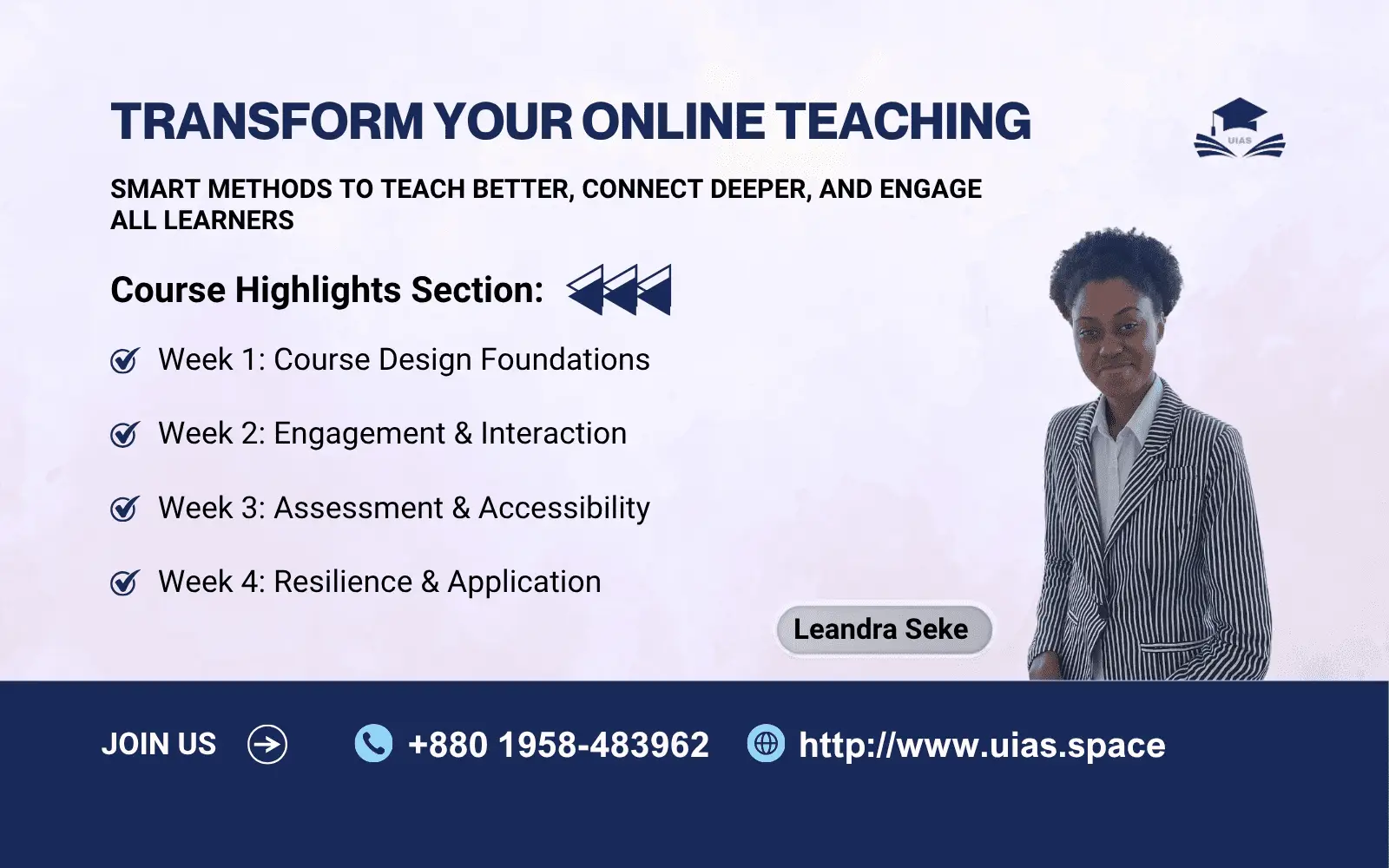
Transform Your Online Teaching: Smart Methods to Engage, Connect, and Inspire(Live Classroom – Book Your Seat Now)
About Course
Course Title: Online Education Strategies: Practical Strategies for Effective Online Teaching
Target Audience: Educators at all levels (Primary, Secondary, Tertiary) transitioning to or improving their online teaching skills.
Course Mode: Online, with a mix of self-paced content and live virtual workshops.
Overall Goal: To equip educators with evidence-based pedagogical and technological tools to design engaging, effective, and inclusive online learning experiences.
Week 1: Foundations of Online Learning & Course Design
Objective: Educators will be able to design a clear and structured digital learning module that reduces learner cognitive load and establishes a strong foundation for the course.
Key Topics:
- Synchronous vs. Asynchronous Learning: Defining the modes and their strategic use.
- Backwards Design for Online: Setting clear learning objectives first, then choosing digital assessments and activities.
- Chunking Content: Breaking down material into digestible, focused segments (microlearning)
- Centralizing Resources: Creating a single, predictable “hub” for all course information (e.g., LMS page, agenda).
Practical Application:
Tool Exploration: Overview of common LMS (Learning Management System) features (e.g., Modules, Announcements).
Week 2: Student Engagement & Interaction
Objective: Educators will learn to integrate at least three new interaction strategies to foster a community of learners and combat isolation in the virtual environment.
Key Topics:
- Building Presence: Teaching presence (clear instructions, weekly videos), social presence (icebreakers, introductions), cognitive presence (discussion prompts).
- Dynamic Discussions: Moving beyond “post once, reply twice” to using protocols, debates, and video discussions.
- Collaborative Learning: Designing meaningful group work and projects for an online setting.
- Formative Assessment Techniques: Using polls, quizzes, and low-stakes checks for understanding.
Practical Application:
Tool Exploration: Leveraging built-in tools like breakout rooms, polls, and collaborative documents (Google Docs, Jamboard).
Week 3: Assessment, Feedback & Accessibility
Objective: Educators will develop a balanced assessment plan for an online unit and apply principles of universal design to ensure materials are accessible to all learners.
Key Topics:
- Rethinking Assessment: Moving from high-stakes exams to authentic assessments (e.g., portfolios, projects, presentations).
- Providing Effective Feedback: Using audio/video feedback tools and rubrics to give timely, actionable input.
- Upholding Academic Integrity: Strategies for test design that discourage plagiarism and cheating.
- Universal Design for Learning (UDL): Providing multiple means of engagement, representation, and action/expression.
Practical Application:
Tool Exploration: Introduction to rubric creators, speech-to-text, closed captioning, and accessibility checkers.
Week 4: Building Resilience & Putting It All Together
Objective: Educators will synthesize course concepts to create a comprehensive implementation plan and develop a personal strategy for managing the workload of online teaching.
Key Topics:
- Teacher & Student Wellness: Avoiding burnout, setting boundaries, and supporting student mental health.
- Iterative Improvement: Embracing a growth mindset and using simple feedback loops (e.g., end-of-week surveys) to refine practice.
- Creating a Sustainable Routine: Time management strategies for managing online teaching tasks.
Final Workshop: Peer feedback session on course plans.
Practical Application:
Final Project: Submit a complete, two-week online learning plan incorporating strategies from all previous modules in oral format
Action Plan: Develop a personal “Digital Teaching Manifesto” outlining their key takeaways and goals for the upcoming term.
Student Ratings & Reviews